
Some links in this article are affiliate links. As an Amazon Associate, Knots & Naps earns from qualifying purchases, at no extra cost to you. This never changes what we recommend. How this site works.
Somewhere on every sailing there is a toddler who only eats yellow food. Not metaphorically yellow. Literally yellow: macaroni and cheese, corn, those little yellow crackers, butter on toast with the butter visible. If that is your operating context, the phrase “rotating through three themed restaurants with a set menu each night” probably reads less like a vacation perk and more like a threat.
Here is the reassuring news up front: rotational dining is built for exactly this situation. But it helps to understand the system before you board.
What Rotational Dining Actually Is
Disney Cruise Line uses a system called rotational dining, which means that each evening at dinner, you rotate through a different themed restaurant. There are three main dining rooms on the Disney Fantasy. Over the course of a 4 or 5-night sailing, you will eat in each of them more than once, and your servers rotate with you.
That last part is the important part: the same server team follows your family from restaurant to restaurant each night. By night two, they know which kid only accepts macaroni and cheese in its plain form with no sauce variations, and which kid will eat anything if you call it “the princess version.” They learn your family. It is a small thing that becomes a large thing over five nights.
The Three Main Restaurants on the Disney Fantasy
Animator’s Palate
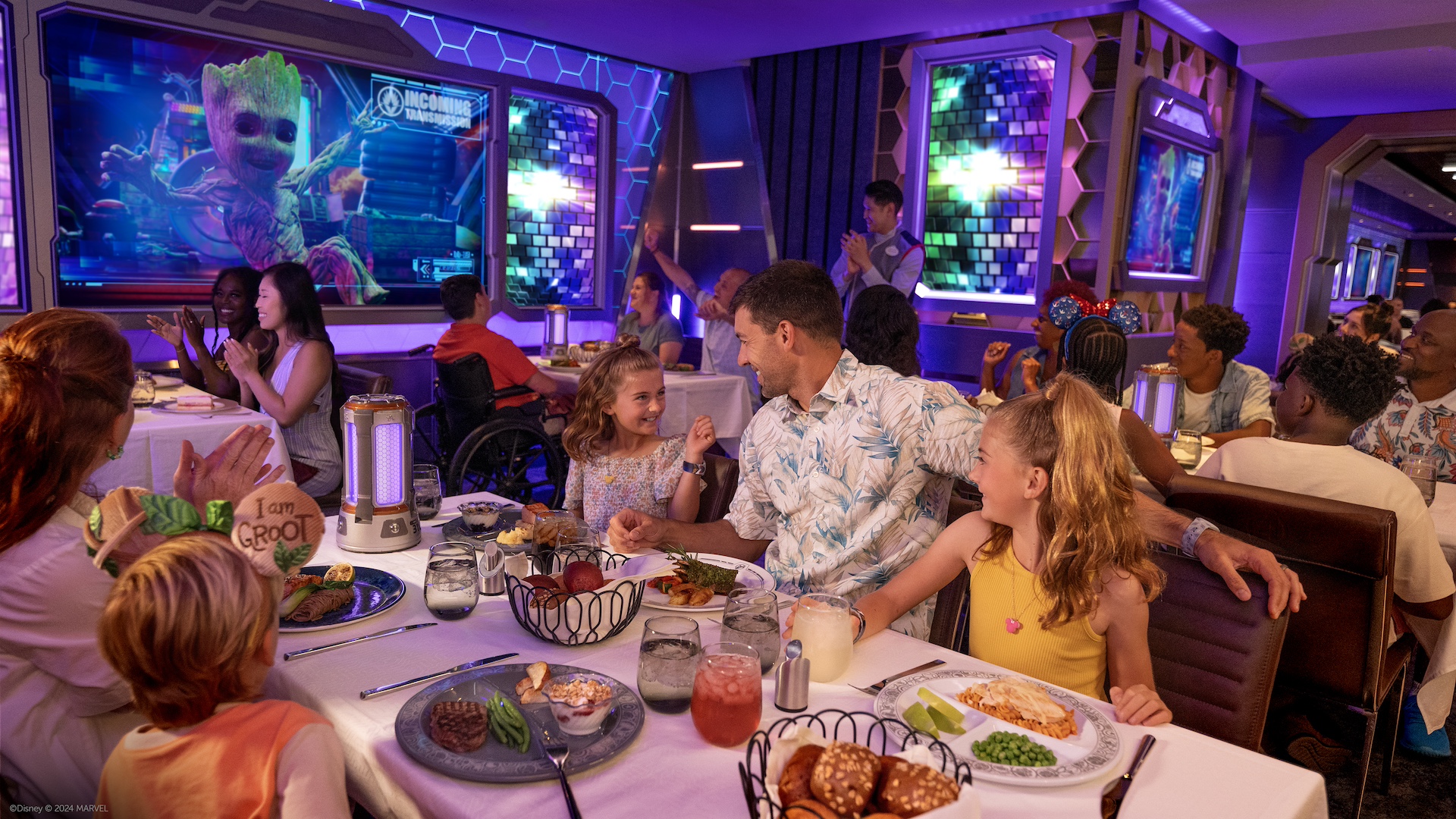
This is the signature restaurant unique to Disney ships. The walls and screens around the dining room shift and animate throughout dinner, and on certain nights there is an interactive component where the kids draw characters that get incorporated into the show. Watching a three-year-old see her own fish drawing swim across the wall screens is, by every account, one of the best moments of the sailing.
The food here is good. Better than good, actually. The menu changes depending on the night. The theming is wonderful for kids and honestly kind of wonderful for adults too. If you only enjoy one rotational dining restaurant, it will probably be this one.
Royal Court
This one is princess-themed, all done in golds and soft colors, and looks like the inside of a fairy tale. There are character appearances by Disney princesses here on certain evenings. It is the restaurant where kids in their best dresses sit unusually properly through the meal, a phenomenon parents report with a mix of amusement and suspicion.
The food at Royal Court skews a little more formal and the menu has options that small children will not touch, but there are always kids’ menu options at every rotational restaurant. The ambiance is beautiful, and for a kid deep in the princess world, this one is a big deal.
Enchanted Garden
This is the most casual-feeling of the three, designed to feel like a French garden with a ceiling that shifts from daytime to nighttime as the evening progresses. The food here is the most varied and arguably the most reliably good across the menu. It is also the restaurant most often named in trip reports as the site of the rare-bird sighting: a toddler voluntarily eating vegetables.
How Dinner Scheduling Works
Your rotation is assigned before you board and you can see it in the app. You also choose a dining time: main seating (typically around 5:45pm or 6pm) or second seating (typically around 8pm). With toddlers, main seating is the answer. There is no version of a two-year-old that is pleasant to be around at 8pm in a restaurant.
Main seating means dinner is done by 7:30 or so, which leaves time for a show or a bit of play before the nighttime routine.
Handling Picky Toddlers at Rotational Dining
Every restaurant has a kids’ menu that does not change. It is the same across all three restaurants: chicken strips, mac and cheese, fish, a hot dog, vegetables, fruit, that kind of thing. We wrote a whole article about handling picky toddler food on a Disney cruise because this menu exists specifically for the yellow-food demographic.
The strategies that consistently work:
Order the kids’ food early. When the server comes, order the kids’ meals first. Hungry toddlers waiting at a table with nothing to occupy them is a recipe for a difficult dinner. Getting their food moving early means they are eating while you are still ordering.
Ask for bread immediately. Every rotational restaurant will bring bread if you ask. Bread buys time. Bread is the currency of dining with small children.
Use the kids’ menu freely and without guilt. Parents trying to talk their 2-year-olds into the adult menu are a nightly dining room spectacle, and it never goes well. The kids’ menu is there for a reason. Use it and order what you actually want for yourself.
Pick the right seating time. Main seating. Not second seating. Please.
The Oceaneer Club is available. If you want one or two dinners as adults, you can drop the kids at the Oceaneer Club and eat in peace. This pairs especially well with a Palo night. You do not need to feel obligated to bring the kids to every rotational dinner.
The Server Relationship
This deserves its own section because it is the part that surprises first-timers most. The stories are remarkably consistent: a head server who remembers on night two that one kid wants the strawberry sauce on the side, and has it there before anyone asks. A server who starts bringing the toddler’s macaroni out first, unprompted, because he noticed the kid gets grumpy waiting.
These are small things. But they add up over five dinners into something that feels warm rather than transactional. Tipping your server team at the end of the cruise is standard practice and those envelopes are in your stateroom. Tip generously. They earn it.
Special Dietary Needs
Disney Cruise Line handles dietary restrictions well. You notify them before you board through the pre-cruise paperwork, and then your server team is informed. Families managing allergies consistently describe it as the least stressful restaurant version of a food restriction they have experienced: the head server checks with the kitchen each night, flags anything to avoid, and handles it without being asked twice.
Is Rotational Dining Actually Good?
The honest answer is yes, for what it is. The food quality is well above typical cruise ship dining, the theming of the restaurants is immersive, and the rotating server team is one of those Disney details that sounds small but changes how the whole week feels. For the casual daytime alternative, Cabanas rounds out the dining picture.
Rotational dining is the thing first-time cruisers most often report being surprised by. The expectation is mediocre buffet-level food. The reality is three of the better restaurant meals of the year, eaten with toddlers at the table, which is its own category of accomplishment.